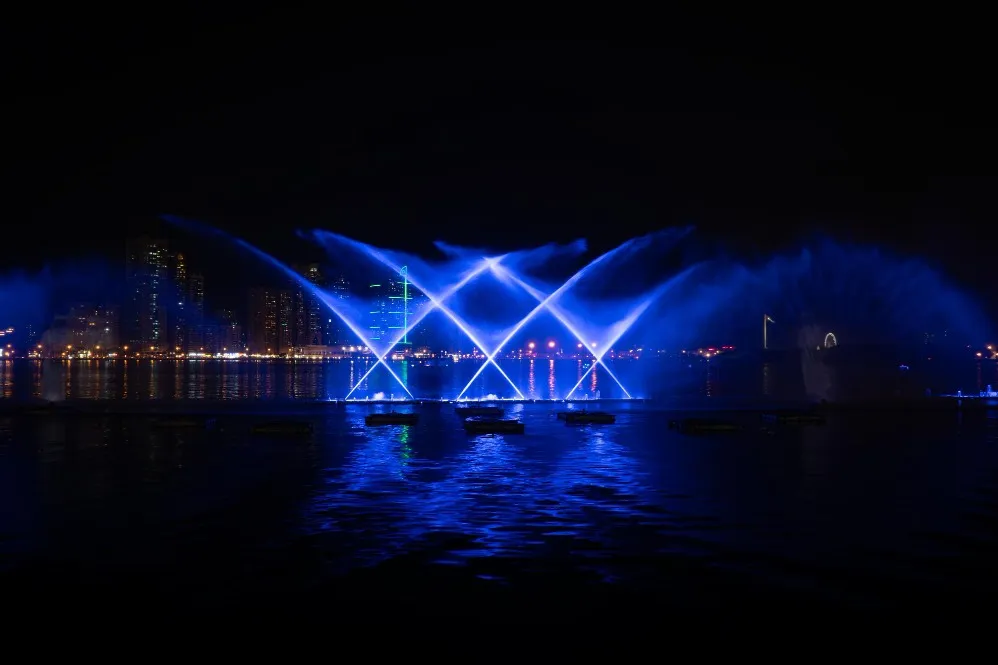
A water feature can become much more than a decorative element when movement, lighting, fountain patterns, and music are coordinated into a planned display. Musical dancing fountains use controlled water jets to create changing visual sequences, making them suitable for properties where the landscape itself contributes to the visitor experience.
They are increasingly relevant to hotels, resorts, commercial developments, event properties, institutions, public-facing premises, and premium residential projects.
What Creates the Dancing Effect?
The appearance of a dancing fountain depends on coordinated control of multiple components. Pumps create the required water movement, while fountain nozzles determine the shape and direction of individual jets.
Depending on the design, a fountain may feature:
- Vertical water jets
- Arcing patterns
- Changing jet heights
- Sequential water movement
- Programmable sequences
- Underwater illumination
- Music-synchronized effects
A well-planned installation considers these elements as one complete system.
Space Comes Before Fountain Style
The available site should guide the design.
A large dramatic pattern may look impressive in a spacious resort landscape but overwhelm a compact hotel courtyard. Similarly, a small fountain may lack visual impact when installed within a large commercial frontage.
Important site considerations include basin dimensions, viewing distance, surrounding architecture, visitor movement, nearby landscaping, electrical provisions, water circulation, and maintenance access.
Water Circulation Requires Careful Planning
Fountain performance depends heavily on hydraulic design. Pumps must provide suitable flow and pressure for the selected nozzles.
Poor planning can result in uneven jets, inconsistent heights, unnecessary splashing, or excessive energy consumption. Water loss also becomes a concern when fountain patterns extend beyond the intended basin area.
Recirculation allows water to be reused within the fountain system, helping make operation more practical.
Lighting Changes the Experience
During daylight hours, water movement is usually the primary attraction. After sunset, lighting can completely transform the installation.
Underwater fixtures can emphasize individual jets and programmed sequences. Lighting positions should be determined during fountain planning so that cables, fixtures, and electrical infrastructure are safely incorporated into the project.
The surrounding environment also matters. Lighting that suits a vibrant event property may be very different from the understated effect preferred by a premium residential landscape.
Maintenance Should Influence Design
Attractive fountains still require practical maintenance. Pumps, nozzles, filters, lights, control equipment, and water quality need periodic attention.
Easy access to serviceable components can reduce future maintenance difficulty. The basin should also be designed so that cleaning does not become unnecessarily complicated.
Nagpur's climate creates additional considerations such as dust, evaporation, and seasonal debris. These factors should be considered during planning rather than after commissioning.
Creating a Feature With Long-Term Value
For properties across Nagpur and other Maharashtra urban environments, musical dancing fountains can become focal points that improve visual identity and visitor experience. Their success, however, depends on more than selecting attractive fountain patterns.
Nagpur Eco Agro supports landscape and water-feature requirements for residential, hospitality, institutional, and commercial properties. A thoughtfully engineered musical fountain can combine architecture, water movement, illumination, and programmed performance into a feature that remains visually impressive while still being practical to operate and maintain.
Keywords